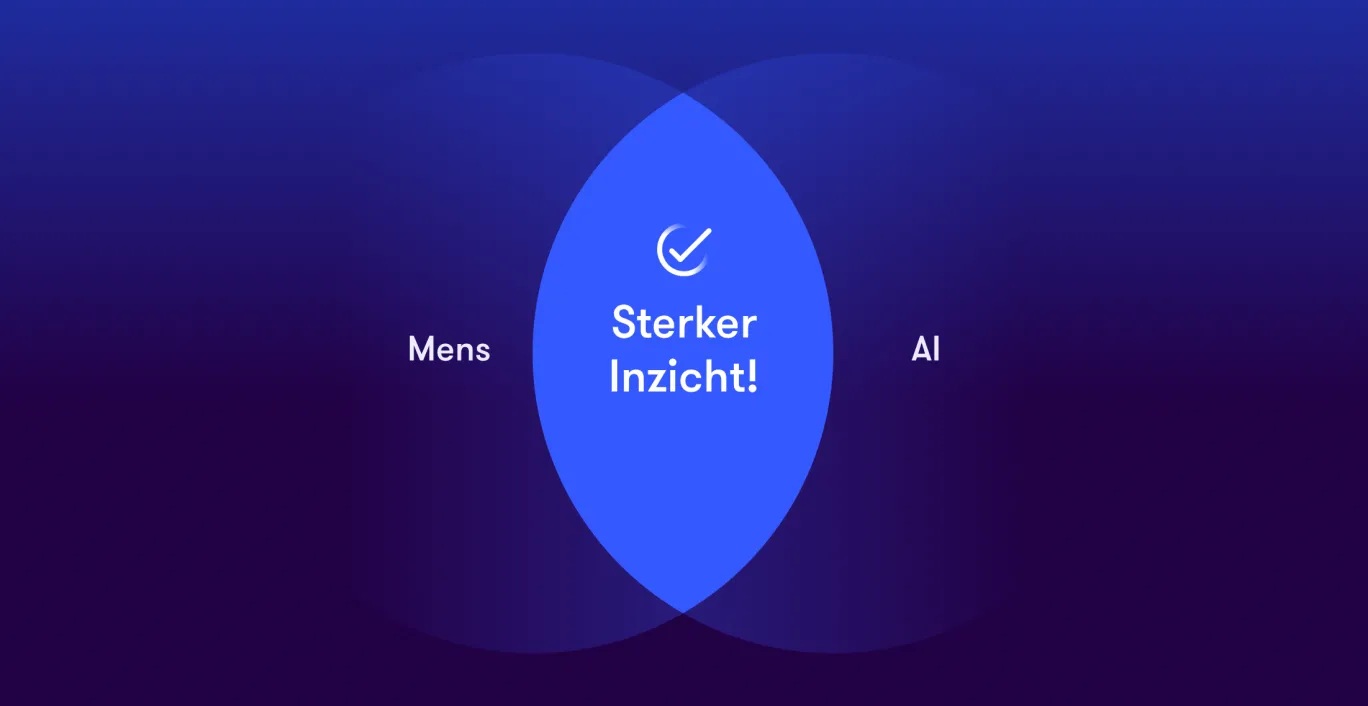
Artificial Intelligence has rapidly evolved from an experiment to a widespread expectation. Executives and senior management know they ‘need to do something with it’, but the question often remains the same: what concrete benefits will it bring to our organisation?
Not as a standalone tool. Not as a side-project. But as part of the digital strategy.
At Concept7, we don’t view AI as a passing fad or a cost-saving measure, but as a strategic enabler. The aim is not to generate output more quickly, but to facilitate better decision-making. That may sound simple, but in practice it makes a real difference.
Why many AI initiatives stall
We often see organisations adopting AI out of curiosity or in response to market pressure. They purchase a tool, launch an experiment or set up a pilot scheme. Whilst this sometimes yields interesting insights, it rarely adds real value or delivers lasting impact.
The reason is simple: AI is often implemented in isolation from strategy. There is no clear link to business objectives, no integration with UX or data architecture, and no clear definition of success. As a result, AI remains a standalone project, whereas its true value is realised when it is integrated into the wider digital ecosystem.
AI only becomes relevant when it helps answer questions such as: Where are we currently losing revenue? Where do friction points arise in the customer journey? Which investments deliver a demonstrable return? How can we minimise risk when making strategic decisions?
That’s where the conversation begins.
Faster insights, stronger justification
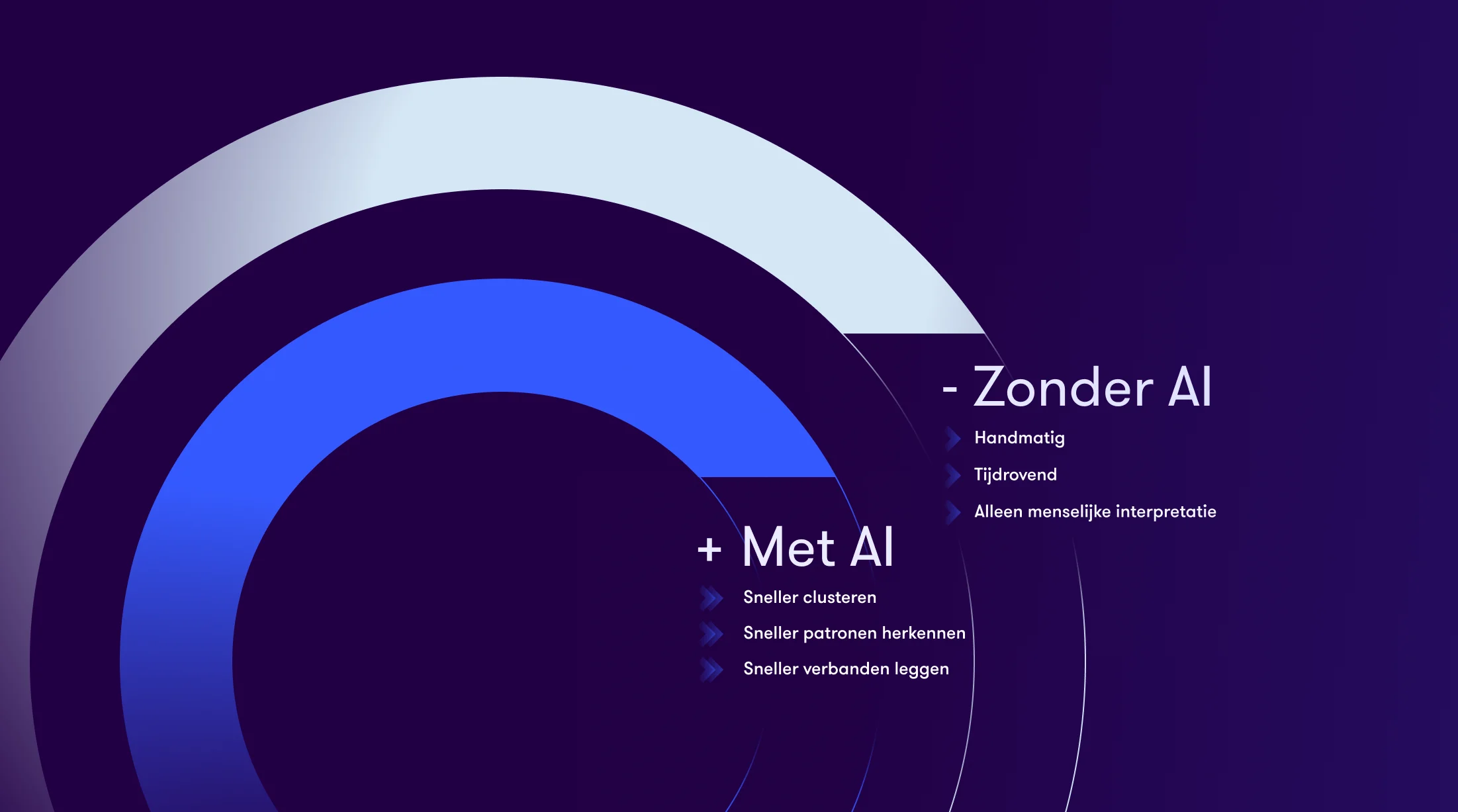
In strategic projects, we often use interviews, workshops, user research and data analysis. This provides valuable input, but also generates large amounts of information. Without AI, structuring and analysing this data takes a great deal of time, and identifying patterns remains partly dependent on human interpretation.
By using AI to analyse qualitative and quantitative data, we can establish connections more quickly, uncover patterns and identify recurring themes. Not to automate conclusions, but to improve data quality and reduce blind spots. The human expert remains in charge, but has access to more insightful input.
For senior management, this means that strategic decisions are better substantiated. Scenarios can be explored at an earlier stage, risks identified more quickly, and assumptions assessed more critically. AI not only speeds up the process but also improves the quality of the underlying insights.

Deeper UX insights without longer turnaround time
AI plays a similar role in UX and user research. Research often yields extensive interviews, transcripts, observations and behavioural data. Analysing these manually is time-consuming and scalable only to a certain extent.
By using AI to structure and cluster research data, patterns become apparent that would otherwise be less obvious. These might include recurring frustrations, subtle behavioural differences between target groups, or users’ implicit expectations.
That does not mean that a model dictates the design. On the contrary. The UX specialist remains responsible for interpreting the model and translating it into design choices. The difference is that decisions are better informed and iterations can take place more quickly.
This is essential for organisations looking to grow digitally. A shorter feedback loop means faster learning and faster improvement.
From recreational optimization to proactive steering.
Many companies use dashboards and reports. They know how many visitors they have, what the conversion rate is, and where people drop out. Yet optimisation often remains reactive. Action is only taken when figures fall or when a problem becomes apparent.
AI makes it possible to identify signals in behavioural patterns at an earlier stage. Subtle shifts in click behaviour or anomalies in conversion funnels can be identified more quickly. As a result, the focus of optimisation is shifting from looking back to looking ahead.
This provides greater control over digital performance. Not because AI solves everything, but because it helps to set priorities and maintain focus. For larger SMEs, this means that investments in digitalisation are made in a more targeted and better-informed manner.
An example of how we apply this
In one of our client projects, we used AI as a supplementary data source. We compared the insights gained from this with the results of traditional qualitative and quantitative research in order to identify patterns and gain a deeper understanding of the findings.
The biggest challenges in this project were reaching hard-to-reach target groups, processing large volumes of research data, and making the best possible use of the available budget.
AI has enabled us to make more informed strategic decisions, streamline our processes more efficiently and provide greater certainty to our customers.
Would you like to find out more about this case? Please get in touch with us.
The difference compared to a traditional approach lies not only in speed, but above all in precision. The combination of AI-assisted analysis and human expertise provided a deeper understanding of the situation and a solid foundation for decision-making.
You can add specific results and figures here later to demonstrate the impact.
What this means for your organization
Ultimately, for senior management, it is not about technology, but about impact and sustainability. If AI helps to reach informed decisions more quickly, reduce risks and accelerate digital growth, then it is strategically relevant.
This doesn’t require a large-scale transformation from day one. It starts with the question: where in our digital supply chain can we make better decisions by gaining better insights?
Sometimes this involves analysing customer behaviour. Sometimes it involves strategic positioning. Sometimes it involves optimising existing funnels. The right approach varies from organisation to organisation, but the underlying principle remains the same: technology must contribute to direction and results.
Curious about the role AI can play in your strategy?
AI is not just a standalone tool or a passing trend, but a targeted enhancement of your digital strategy. Together, we’ll identify where AI truly adds value, where it can accelerate progress, and where it can bring greater depth. This isn’t just hype, but a well-considered step towards a future-proof digital strategy.
We have compiled all these insights into an e-paper. In it, you’ll discover how to use AI to explore new perspectives, make better-informed decisions and boost creativity. Among other things, you’ll find:
Practical examples of AI in your day-to-day work
Tips for writing better prompts
Insights into how to use AI in creative processes
Applications for strategic issues
Tips for using AI as a critical sparring partner
Use it as a way to get to the heart of the matter more quickly, discover new perspectives and make decisions with greater confidence.
Download the e-paper using the button below. Do you have any questions? We’d be happy to help.