
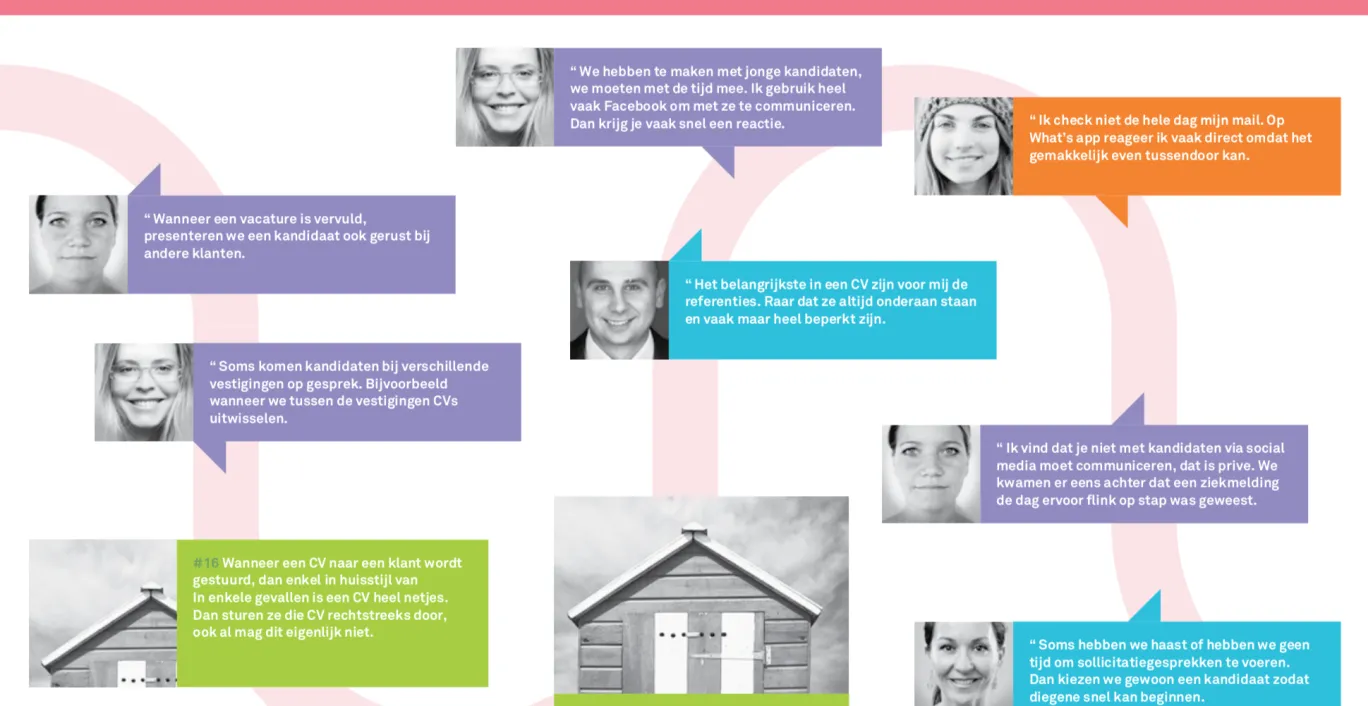
The Customer Journey, or customer journey, is a (visual) representation of the journey your customer takes before buying your product or service.
In a series of two articles, we will discuss what a customer journey is, what you can do with it and how to set it up. This practical guide is part of our Design Thinking toolkit.
This first part is about the Customer Journey. In the second part, we explain how you can easily map a customer journey yourself and what you need to do it.
What is a Customer Journey?
Suppose your washing machine is broken and you need to look for a new one. How will you proceed? And what is important to you in doing this? What are the problems you experience when dealing with this? And where do you start?
A lot happens from the moment the washing machine breaks down to using the new, replacement machine.
You ask family or friends for advice on which washing machine brands are good. You search online for tests of washing machines. Shares found machines via Whatsapp with your partner, for example.
In the evening, you look at prices on websites, see a targeted ad on Instagram and still decide to take a closer look at some machines in a nearby physical shop.
The set of needs, steps, actions, questions and, for example, problems you have and experience when looking for and buying that one new washing machine is called the Customer Journey or customer journey.
On the one hand, it is the overall experience when performing that task. And on the other hand, the individual needs, actions and, for example, pain points, which make the customer experience and thus customer journey.
Researching and understanding a customer journey is an excellent way to understand what happens to people around making a decision or using a product.
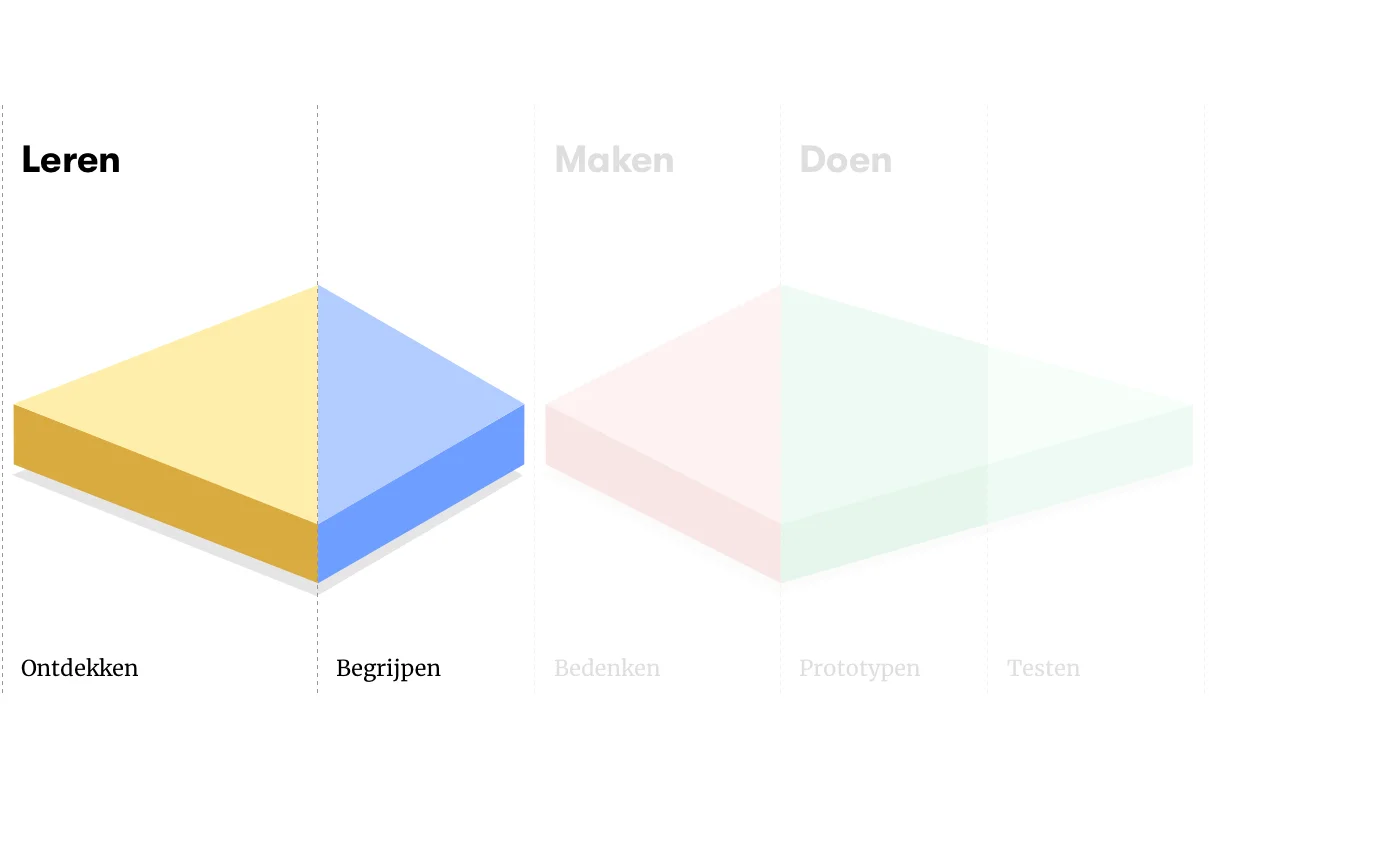
We often use this tool in the 'Learning' phase of Design Thinking, converting all research findings into insights.
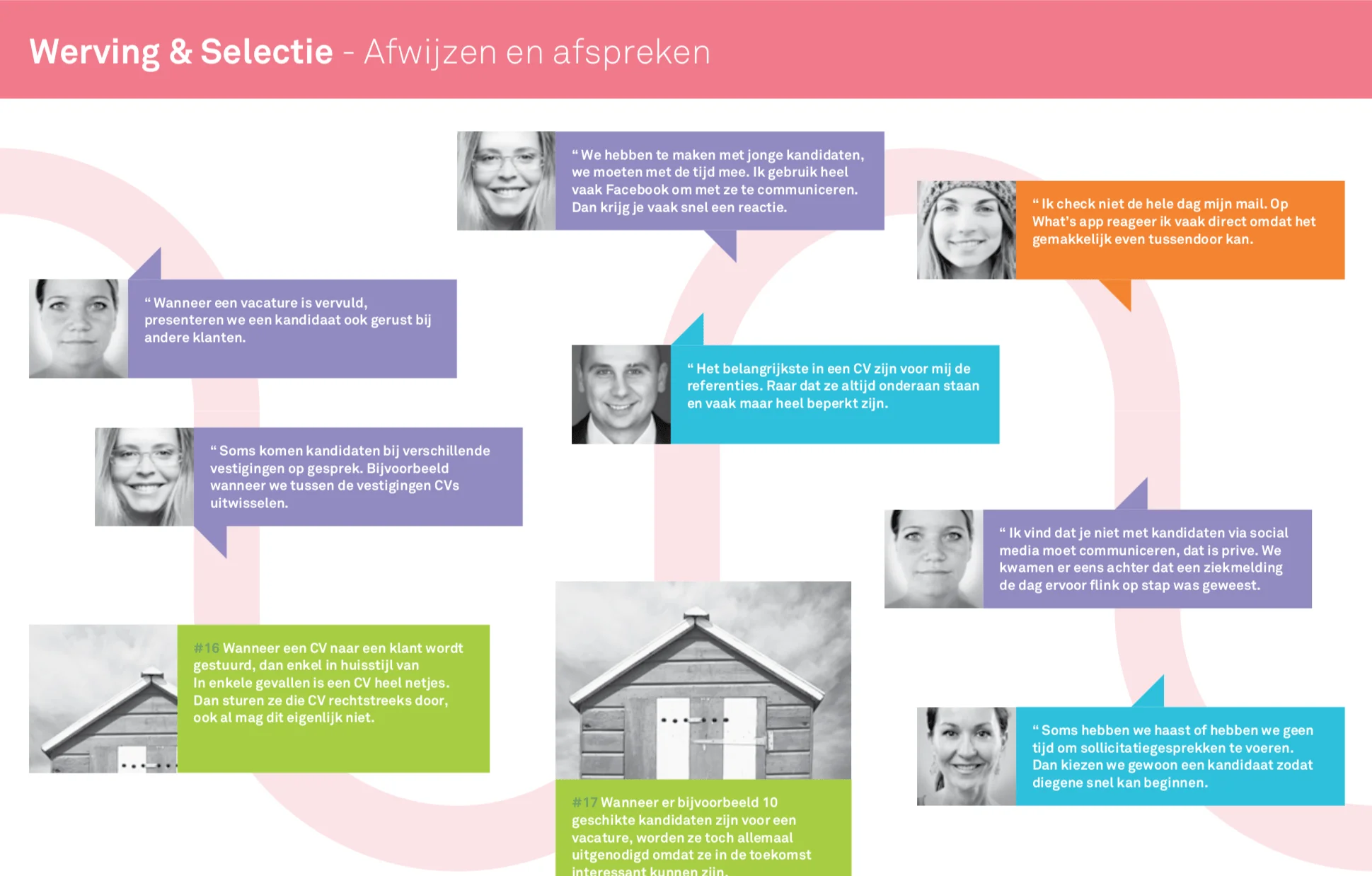
Customer Journey Map
The moment you make the customer journey transparent and visualise it yourself or with a team, it is called a Customer Journey Map. And the tool or method you use to understand and visualise a customer journey is called Customer Journey Mapping.
A Customer Journey Map is a simplification of reality. It tells the story of a customer or end-user, but not of all end-users.
It is a specific story of specific people and what they go through in achieving a specific task. And that can be anything from buying a product to using it.
Download ons customer journey template en start direct.
What does a Customer Journey Map look like?
No two Customer Journey Maps are the same or look the same. Brands, products, consumers, leads and contexts differ. But so do organisations, teams or stakeholders.
You have a Customer Journey Map for buying products, which is also called the 'Buyer Journey'. But you can also create a Customer Journey Map for sending a card, booking a trip or when looking for new staff.
Parts of a Customer Journey Map
A Customer Journey Map has three main parts you can start filling in: context, the experience and the insights.
Context
A good customer journey always starts from a (1) persona that has a particular (2) reason for achieving a particular (3) goal.
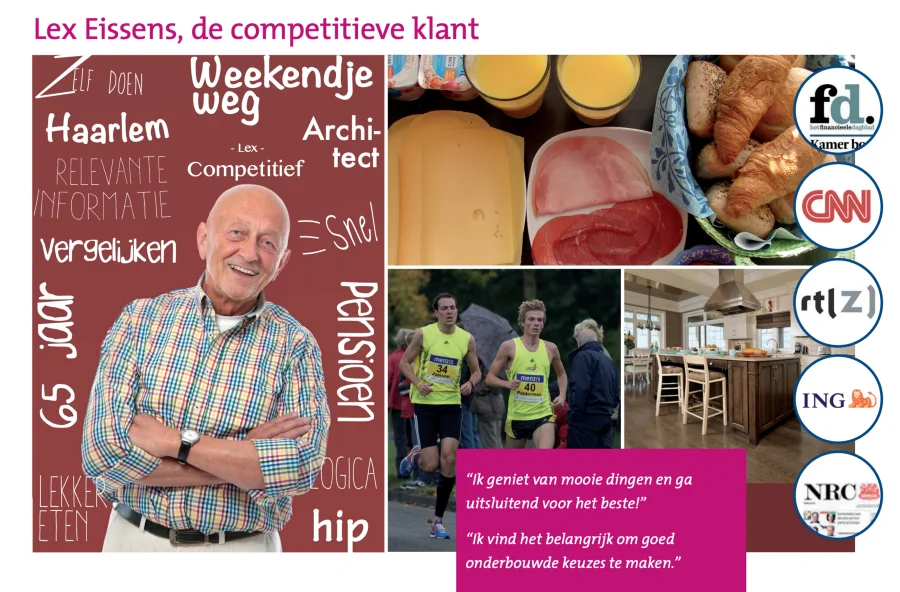
Importantly, when setting the context, you should base it as much as possible on real-world experience. What are customer segments that you can distinguish? Is there evidence of this? What are common leads and targets? How do you know this?
Make as few assumptions as possible, but work with what you know for sure.
Make the step from customer insights to concrete improvement actions with our experts.
The experience
You do the actual visualisation of the customer experience with a number of components. With these, we will break down the customer journey into individual pieces to understand exactly what is happening.
The experience is an interpretation or analysis of available data and/or insights found.
Timeline with phase
The timeline is the thread of your customer journey. It is the stages that consumers or users go through in realising their goals.
For example Orientate > Evaluate > Choose > Buy > Deliver > Use.
You are not stuck with this right away, during the creation of the Customer Journey Map it will most likely be adjusted anyway.
Actions
What actions are taken within each phase? What does persona Lex do during the Orientation phase to be able to proceed to the Evaluation phase? For example, in this example, Lex will need to get an overview of suitable washing machines, which he can evaluate further.
Insights
With investigations, you have gained many insights, which you can start processing at each stage. What have you seen or heard? Initially, you work with all available insights. At a later stage you can further subdivide your insights into, for instance, questions, needs, emotions and/or pain points.
Pain points and opportunities
Where do things go wrong in the customer journey and why? And where are things going well or do we see opportunities? Is it something small but can people move on, or is it a fundamental issue that causes the customer journey to break off prematurely?"
Channels and touchpoints
Including channels and touchpoints is optional in a Customer Journey Map. Include these if you want to get an overview of a total customer journey.
If you focus only on your own site or shop, you can name the pages users interact with here, for example.
In our example, we assume an overarching customer journey, with Lex using various sources and channels.
What can you do with a Customer Journey Map?
Customer Journey Mapping is an ideal way to understand what customers or users go through when performing a specific task. Like buying a new pair of shoes or paying a bill.
By bringing together as much available data, knowledge and research as possible, you get a good picture of who your customers are, what their needs are and what they are up against.
With these insights, you can find opportunities and turn them into possible promising ideas and content. Or a new business idea. You do this in the 'Create' phase of Design Thinking.
Better products and services
With a Customer Journey Map, you can improve products and or services, by making them more responsive to customer needs.
You can do this with existing products, such as a website or an app. But also when finding new business opportunities, if you identify a problem for which there is not yet a good solution in the market.
For example, we once SPRS.me was conceived and elaborated, where we found the customer journey for booking and experiencing a surprise trip, to be the differentiator in a competitive market.
Writing better content
Writing and marketing content also works better if you know who you are writing it for and at what stage in the customer journey it is offered.
Consumers who are still getting their bearings on a mortgage will look for different information than consumers who have been properly informed and are about to make a choice to take it out, for example.
By looking at what the information needs are for each phase, you can start writing targeted content and capture them in a content plan or calendar, for example.
Find out how we work with your team to visualise and improve a customer journey.
Thinking the court
Developing a Customer Journey Map also has benefits for organisations themselves.
Involving stakeholders in developing a Customer Journey Map, often provides essential information and insight about how customers behave and why. Information that can be used to initiate a change in culture to become more customer-centric.
In addition, you can also use a Customer Journey Map to:
Align organisational vision and/or business objectives with user needs.
Gain better and shared understanding, coordination and collaboration between stakeholders and e.g. departments.
Find and assign product owners for specific components.
Make quantitative and qualitative data understandable and insightful.
How next?
In the next part on Customer Journey Mapping, we are going to explain how to easily map a customer journey yourself and what you need to do it.
We tell you which steps to take and which tools to use. In the concluding third part, we give you some tips to help you avoid falling into common pitfalls.
Over Concept7
With more than 20 years of experience in researching and designing digital products and services, we know what is needed for the highest conversion and best experience. That is why we use the proven design methods Human Centered Design and Design Thinking: the user is truly our focus.
Would you like to know more about Customer Journey Mapping or if you can't figure it out yourself, we can always help:
Developing the right strategic basis together to start working customer-centric.
Doing research for your customer journey.
Developing the customer journey.
Turning insights into ideas and prototypes.
Testing prototypes.
Training and master classes on customer journey mapping and other tools.