Do you know your users? Do you ask them questions? Do you engage with them? And do you include them in almost every step of your service or product development?
Only in case of a resounding "yes" may you skip this article. If in doubt: take a seat and find out how Human Centered Design (HCD) improves your product or service.
In this article...
we take you through the upper room of our UX expert Sjoerd Walinga. We discuss the entire Human Centered Design (HCD) process, largely based on the srprs.me case.
srprs.me is a Dutch travel company with now thousands of different surprise trips to its name to over 50 different destinations.
Sjoerd Walinga is our walking encyclopaedia in the field of Usability & User Experience. Over the years, he has had the most diverse clients with complex issues in front of him. He also gives training courses at the Beeckestijn Business School and at Emerce, among others.
That in 12 years he still hasn't run out of things to say about Human Centered Design is for a reason:
Whether it's a council website or a web shop: in those 12 years I've been applying Human Centered Design, the process always produces results.

Sjoerd Walinga
Usability & User Experience Expert
After this article, you will never forget:
what the principles of Design Thinking are;
that Design Thinking and Human Centered Design are not the same thing;
how to tell customer experience (CX), user experience (UX) and service design apart;
to include the Double Diamond model during the design process;
how important your end-users are.
Go directly to
Ask yourself the question: how can you solve something for someone else?
As a business or entrepreneur, you probably tend to go straight into solution mode. You follow a direction that's in your head, but that doesn't mean that's the right solution for anyone else.
And that is precisely the beauty of HCD. In this working method, you start looking very specifically at how to solve something for someone else. Because when you listen to your target group, the results are much more efficient and effective than when you only think in terms of your own solutions;
If you don't follow the Human Centered Design process, you are shooting with hail and gambling on success.
Sjoerd Walinga
Usability & User Experience Expert
HCD is an investment, but you are many times more likely to have a bull's-eye. Just off the mark? Then you can adjust more easily and still throw a bull's-eye.
New and existing products and services
Often, you start with an idea and implement that idea, without involving people in it and with hopes of success. And that's a shame, because you can easily assess potential success. Involving people has two major advantages:
You learn what the needs, expectations and frustrations are of your target audience.
You can validate your product or service. After all, your target audience can tell you what it needs.
Note! What people say is not always what they do. And what they do is not always what they say. In the case of srprs.me, it was a totally new product. So how can people know beforehand whether they are really going to use it?
With new products, you run a risk because you don't know whether it will really catch on. To minimise this risk, it is important that you stay as close as possible to the needs and wants of potential users.
In the case of improvement, i.e. with an existing product or service, you can more easily find people who already know it or have experience with it. When you make such a product or service better for them, you are more likely that these people will use the product or service in the future.
Also ask through: why is there no need?
When there is no immediate enthusiasm from your potential audience, it is still interesting to find out more. When people say they wouldn't use your new product or service, why not? Is it not needed? Is it too complex? Does the designated person feel no common ground with it?
We go back to the birth of srprs.me
It started with Stefan: one of the founders of Concept7 who had time for a holiday after a UX conference in Barcelona.
So what did he do? He asked our then office manager to book him a random plane ticket: "I'll see where I'm going at the airport". Destination? Marrakesh. Once back in the office, he enthusiastically shared his amazing holiday stories.
No more hassle of planning and plotting your trip and only discovering where you are going at the airport? That sounds great, but is there really a demand for it? We asked more than a thousand people this question.
80% of those surveyed responded enthusiastically: I do want to use this. This was such a large group that we could not ignore this idea. So it was time to set up an MVP: a Minimum Viable Product.
Minimum viable product
A minimum viable product (MVP) is the first version of a new product or service that allows you to learn as much as possible about what customers want with as little effort as possible. The idea is to quickly get feedback (validate) and, based on that, further improve the product or service.
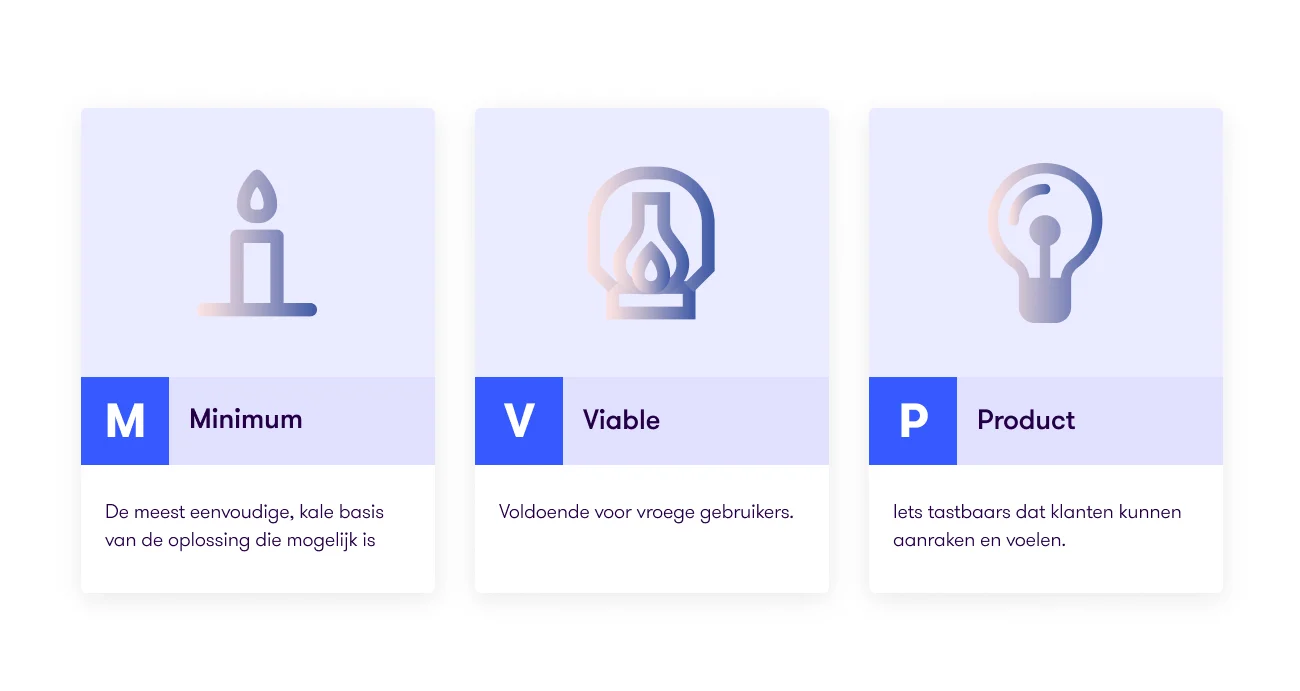
With srprs.me, we targeted people who like to make spontaneous decisions and really like adventure, but also for people who want to avoid holiday stress. With this in mind, we quickly set up a minimal website. And after that? Set up ads and see if it attracts traffic.
From the very first bookings, it was possible to receive feedback from real customers. By constantly asking, listening and applying, you build a successful product or service step by step.
From initial insight to reframing
Before you market your product or service, ask yourself: what is really the problem and how could we solve it?
In the exploration phase you only possess an idea and start testing it. Do people value your idea?
Yes, then you start to give your product or service hands and feet. In this first development phase you build the basis of your product or service (minimum viable product).
The basis is in place and the first users (customers) are a reality. These users you ask for feedback. And the latter? Is actually a never-ending story.
The essence of HCD: first immerse yourself in your users, then explore solution approaches, and from there you hone and validate. And that on-going. People continue to play a constant role during this process.
We saw that the bookings being made were mainly students. With that insight, we started interviewing that target group further and were able to create clear personas.
Human centered design in daily life
Just think about public transport. Previously, you had to have an OV chip card, for example. For many people, the threshold of such a card became too high. Because: suppose you only use public transport a few times a year, you have to buy such a chip card. That is a hassle. That's why you can now do it with your mobile phone or bank card.
Design Thinking vs. Human Centred Design
In the world of design, you often hear of both "Design Thinking" and "Human Centered Design". Although these terms are often used interchangeably, they represent different approaches and concepts within the field. We briefly outline the main differences.
Design Thinking is a way of thinking, a philosophy that teaches you to tackle problems in a creative and iterative way. Rather than a set roadmap, it is a mindset that encourages you to think outside the box, experiment and ultimately find solutions that add real value. Design Thinking is about understanding user needs, empathising with their experiences and iteratively developing ideas that fulfil those needs.
The principles of design thinking
Work in a team:only you go faster, together you get further.
Make it visible:print personas and customer journeys and hang them up. That printing/hanging up also applies to inspiration, sketches and prototypes, etc.
Develop your empathy:deep down into the user.
Be optimistic:your own attitude is also decisive in success.
Trust your creativity:it's not about how creative you are, but how you are creative.
Make it:by making it visible, you can already spot the first areas for improvement. And you will then have something you can test on people.
Learn from mistakes:children's diseases and major risks you mitigate as much as possible. But to whatever extent you do that, you also undoubtedly learn during the process by doing.
Explore multiple directions:your first solution is never the best. So think of several possible solutions and then see which one is the most effective.
Iterate, iterate, iterate:You are better off making a product or service a little bit better each time, than trying to do it (immediately) perfectly. Then you stand still for too long.
On the other hand, Human Centered Design (HCD) is primarily a step-by-step approach, a methodology that gives you guidance when designing solutions. HCD focuses on following specific steps-such as research, prototyping, testing, and implementation-to arrive at a final product that actually meets the user's needs. It provides concrete methods and tools to ensure that every step in the process is user-centric.
In short; where Design Thinking invites you to look at challenges with a certain mindset, Human Centered Design gives you a structured process to address those challenges. The combination of both approaches is hugely powerful in that one is about how you think, while the other tells you what to do.
User experience: design is made for people
User experience (UX) creates an 'experience' for 'users'. For that, you need to understand the 'user'. But if you don't understand people enough, how do you know you have a good design? So user experience cannot be done without Human Centered Design either.
So do you want to make good products and services? Then you have to put the user at the centre of the design process. And you do that through the HCD process.
Improving your product or service at different organizational levels
At different organisational levels, you can work on improving your products and services.
Customer experience
Customer experience (CX) is about the experiences of all products, services and touchpoints in your organisation. From how someone answers the phone, the letters you send to how you are helped as a customer in an organisation.
User experience
Then you have user experience (UX): that's the level of all the digital products, services and touchpoints your organisation has and users interact with. From a website, an app, intranet, customer service system to a student learning programme.
You could say: user experience is the digital service within your entire customer experience, which also includes the analogue service. If you have a very easy-to-follow website, but your staff are very sour on the phone, that still comes at the expense of your overall customer experience.
Service design
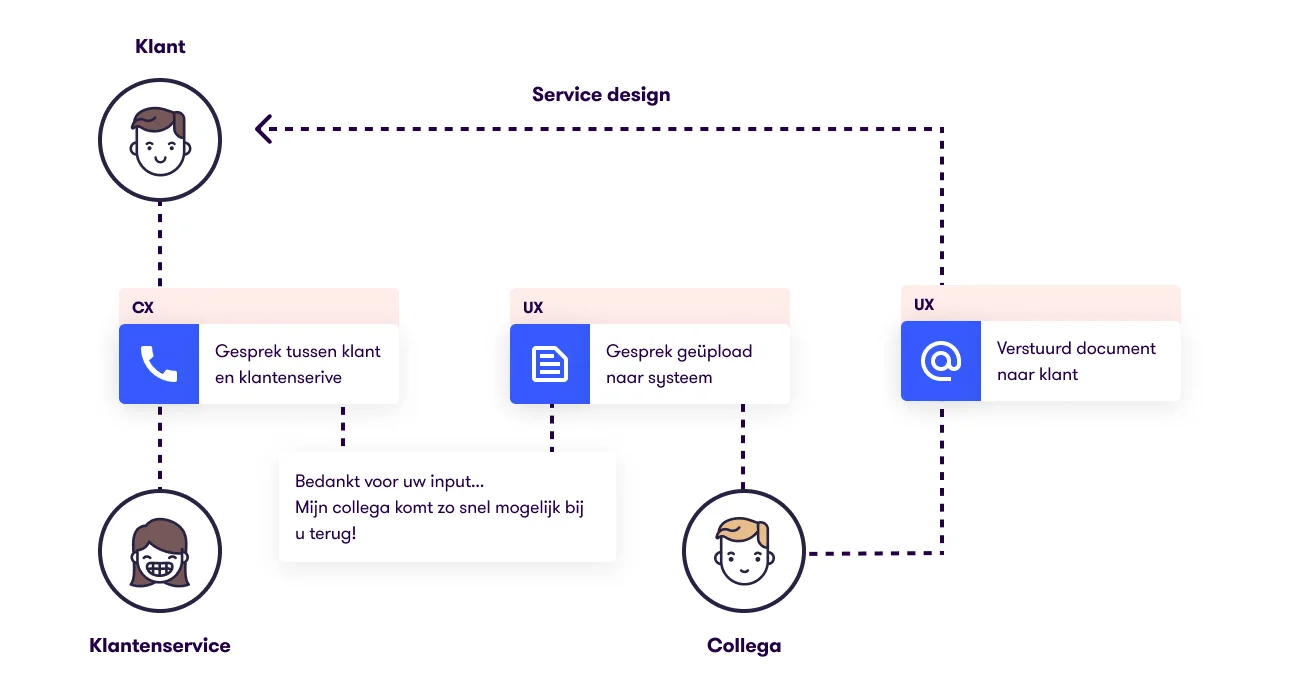
Service design is in between the two. That links UX with your CX and vice versa. Service design focuses on creating seamless and meaningful interactions between customers and service providers, and optimising the various touchpoints in the service process.
An example of service design
An example of service design is redesigning a customer service process at an online shop. Through service design, the online shop can increase customer satisfaction by optimising the entire customer journey.
For example, when someone calls customer service, this is entered into the system. With that entering into the system, comes UX. But that call is CX. Another colleague takes over (CX). And who sends that, for example, in a document to your e-mail (UX).
The Double Diamond to apply Human-Centered Design
But how can you use the Human Centered Design method yourself when launching and improving your own product or service?
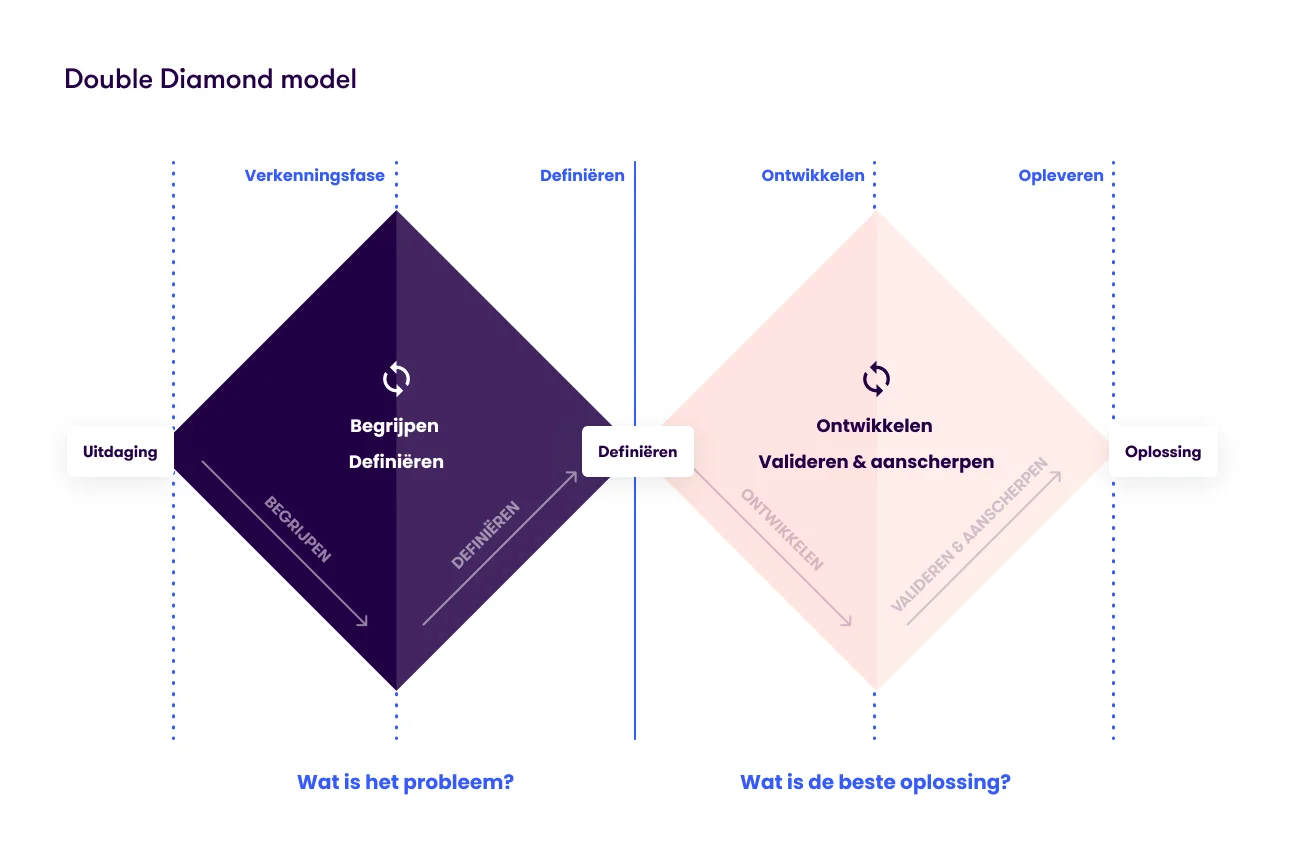
The Double Diamond is a beautiful visual translation of the HCD process. The Double Diamond applies well to many companies and issues.
The first diamond: the problem
The first diamond focuses on the problem. You delve into what people need. Before developing a solution, you need to understand what problem you are trying to solve. This helps you understand the users and the organisation, rather than simply making assumptions.
In the discovery phase, your goal is to fully immerse yourself in the problem through research. The insight gathered in this phase can help you define the challenge. In the definition phase, your goal is to turn your research data into a final problem statement (the design challenge).
The second diamond: the solution
The second diamond focuses on the solution. In the development phase, your goal is to generate possible solutions to your defined problem (design challenge). From abstract to increasingly concrete.
The delivery phase gives you time to validate whether the possible solutions will work with the specific target audience. Are you in the right direction? You eliminate the solutions that don't work with early prototyping and testing. Eventually, you focus more and more on the right solution and keep iterating until the solution is completely finished. The biggest changes are at the beginning, and later you keep improving constantly.
Diverging and converging
The model has a diamond shape because it revolves around divergence (coming up with as many solutions and ideas as possible) and convergence (making choices).
For divergence, for example, you can use insights from interviews to have a brainstorming session and come up with as many ideas as possible.
You have main issues and side issues. Users name things that are relevant to solving the problem, but also things that are less relevant. So when converging, you make a prioritisation. You include this prioritisation in your backlog, for example.
Why it is important to do this as a team
There is almost always some form of bias in this process. Because when is something relevant or not? If you add in that mindset of human-centred design, it is important that you do it as a team. So the process never rests on one person.
Intersection between the organisation and users
When mapping people's needs, expectations, frustrations and desires, it is important to also involve someone who can talk about organisational goals: what do we stand for as an organisation and where do we want to go?
Balancing business objectives with user needs and expectations is essential. Business objectives are important for the organisation, while needs and expectations are crucial for the user. The interface between the organisation and the users offers the most benefit and the greatest chance of success.
Better to test something than nothing
Rather not just ask your family, colleagues or friends. Still, it's always better than asking nothing of anyone.
Need quick input? Get someone from HR or Finance involved. These can be people far removed from the product the creation team is building. You can also run a pop-up on your own website or do a campaign via social media.
But should we put something on your mind, it is this: don't make assumptions, and ask your users.
What does the future of Human-Centered Design look like?
The world around us never stands still. Society and the economy are constantly changing and technology is evolving at breakneck speed. The beauty of human-centred design is that you can continue to solve any problem and cope with any change regardless.
Understanding people's needs, expectations and frustrations allows you to keep spotting opportunities. That way, you are much more likely to create something that is meaningful and beneficial to yourself. So this process, we never say goodbye to that.
Work with us to understand your users?
Did you get all excited about Human Centered Design after this article, but would like our experts to think along with you?